
In stock

Kurdish Jajim
Size: 1.95m x1.30m (6'4 x 4'3) £475.00
Kurdish Jajim Kurdish Jajim is a small village near to Heriz in the Azerbaijan area of Northwest West Asia, one of the most prolific weaving...
Add to basket
In stock

Qashqai Rug
Size: 0.65m x 0.60m (2'1 x 2'0) £195.00
The Qashqai tribes who weave these beautiful rugs are particularly well known for their use of vibrant colours, achieved through high quality, hand spun and often natural dyed yarns. The designs are well executed showing Caucasian influence, with the "chain medallions" frequently encountered, along with combs, stylised birds and animals. They are woven on a horizontal ground loom, with a foundation of ivory woollen warps and characteristically red dyed wefts, having edges over wrapped in different coloured yarns.
Add to basket
In stock

Qashqai Rug
Size: 0.65m x 0.65m (2'1 x 2'1) £195.00
The Qashqai tribes who weave these beautiful rugs are particularly well known for their use of vibrant colours, achieved through high quality, hand spun and often natural dyed yarns. The designs are well executed showing Caucasian influence, with the "chain medallions" frequently encountered, along with combs, stylised birds and animals. They are woven on a horizontal ground loom, with a foundation of ivory woollen warps and characteristically red dyed wefts, having edges over wrapped in different coloured yarns.
Add to basket
In stock

Qashqai Rug
Size: 0.60m x 0.60m (2'0 x 2'0) £195.00
The Qashqai tribes who weave these beautiful rugs are particularly well known for their use of vibrant colours, achieved through high quality, hand spun and often natural dyed yarns. The designs are well executed showing Caucasian influence, with the "chain medallions" frequently encountered, along with combs, stylised birds and animals. They are woven on a horizontal ground loom, with a foundation of ivory woollen warps and characteristically red dyed wefts, having edges over wrapped in different coloured yarns.
Add to basket
In stock

Qashqai Rug
Size: 0.65m x 0.65m (2'1 x 2'1) £195.00
The Qashqai tribes who weave these beautiful rugs are particularly well known for their use of vibrant colours, achieved through high quality, hand spun and often natural dyed yarns. The designs are well executed showing Caucasian influence, with the "chain medallions" frequently encountered, along with combs, stylised birds and animals. They are woven on a horizontal ground loom, with a foundation of ivory woollen warps and characteristically red dyed wefts, having edges over wrapped in different coloured yarns.
Add to basket
In stock

Bidjar Rug
Size: 0.72m x 0.52m (2'6 x 1'8) £295.00
Bidjar is the name of a small Kurdish town in western West Asia. Kurdish carpets are often very strong and compact, which makes them extremely durable. The weavers use their heavy comb, made of metal and wood, to beat the weft and the knots, so that the pile almost stands up. The surface of the pile, therefore, becomes very compact, which prevents gravel and other small particles to be pressed into the carpet. The carpets are made with Turkish knots and are generally red and blue with beige elements. The most common pattern is the Herati (also called fish pattern), but also medallions and floral motifs occur. Bidjar carpets are manufactured in most sizes. They have a sober elegance and fit in most environments.
Add to basket
In stock

Qashqai Rug
Size: 0.60m x 0.60m (2'0 x 2'0) £195.00
The Qashqai tribes who weave these beautiful rugs are particularly well known for their use of vibrant colours, achieved through high quality, hand spun and often natural dyed yarns. The designs are well executed showing Caucasian influence, with the "chain medallions" frequently encountered, along with combs, stylised birds and animals. They are woven on a horizontal ground loom, with a foundation of ivory woollen warps and characteristically red dyed wefts, having edges over wrapped in different coloured yarns.
Add to basket
In stock

Qashqai Rug
Size: 0.60m x 0.50m (2'10 x 1'8) £195.00
The Qashqai tribes who weave these beautiful rugs are particularly well known for their use of vibrant colours, achieved through high quality, hand spun and often natural dyed yarns. The designs are well executed showing Caucasian influence, with the "chain medallions" frequently encountered, along with combs, stylised birds and animals. They are woven on a horizontal ground loom, with a foundation of ivory woollen warps and characteristically red dyed wefts, having edges over wrapped in different coloured yarns.
Add to basket
In stock

Vintage Sarouk Rug
Size: 0.73m x 0.50m (2'4 x 1'7) £135.00
Vintage Sarouk Rug c.1940's
Add to basket
In stock

Ziegler Rug
Size: 1.48m x 0.90m (4'10 x 4'11) £520.00
This is a relatively new production designed to emulate the carpets woven by Ziegler & Co in the late 19th century. These modern Ziegler carpets are hand-woven by mainly Turkoman weavers of Afghanistan in the border regions of Pakistan. They are woven using vegetable dyed, hand-spun Afghan wool, on a cotton warp and weft foundation. These Ziegler rugs and carpets are available in an assortment of palettes, ranging from a mellow aged appearance with subtle tones to more vibrant colouring for dramatic effect
Add to basket
In stock

Afshar Rug
Size: 2.03m x 1.62m (6'7 x 5'3) £1,400.00
Afshar Rug These colourful carpets and rugs are hand-woven in Fars province of south-west West Asia and are brought to market in the Capital city...
Add to basket
In stock

Meimeh Rug
Size: 4.25m x 3.10m (13'11 x 10'2) £4,000.00
Meimeh Rug This vibrant Kazak has been hand woven by Afghan tribal people in Pakistan. It is based on the traditional Caucasian designs and woven...
Add to basket
In stock

Nain Rug
Size: 2.02m x 1.25m (6'8 x 4'1) £850.00
Nain Rug Nain Rug is situated in mountainous country within an important weaving area in North West West Asia. The carpets taking the name of...
Add to basket
In stock

Kashan Rug
Size: 3.07m x 1.95m (10'1 x 6'4) £1,900.00
Kashan is a city in the North of central West Asia and is famous for weaving some of the best quality carpets being produced. They are exceptionally hard wearing and highly decorative. These elegant rugs are constructed on a cotton foundation with a woollen pile, sometimes having accents of silk or woven entirely with silk.
Kashan rugs have been crafted since the 16th and 17th century, during the Safavid dynasty, with many scholars believing that some of the smaller silk designs date back to the early 16th century. Taking inspiration from the architects and artists of the period.
Many Kashan’s are distinctive with their traditional floral designs with deep reds and blues in the centre panel and border. They can also have only small accents of red and a main ground of mostly ivory and navy, making them similar to a Nain but woven in the city of Kashan. Depending on their size and colour they can work very well in both a bedroom as well as a hallway or living room for example.
Add to basket
In stock

Mahal Rug
Size: 3.04 x 2.12m (9'11 x 7'0) £1,900.00
Mahal Rug https://www.rugandcarpetstudio.co.uk/shop/?post_type=product&p=81823 Construction: woven on cotton warps using hand spun vegetable dyed wool. This is a modern twist on an old design originally woven...
Add to basket
In stock

Kazak
Size: 2.80m x 1.50m (9'2 x 4'11) £490.00
This vibrant Kazak has been hand woven by Afghan tribal people in Pakistan. It is based on the traditional Caucasian designs and woven with good quality wool yarns, using natural vegetable dyes. It has a cotton foundation and could work very well under a dining table, in a living room or an open plan kitchen for a pop of colour. Each of our handmade rugs are unique pieces and this new Kazak is a fine example of what is being woven by Afghan tribes today.
Add to basket
In stock

In stock

Bidjar Rug
Size: 1.53m x 1.04m (5'0 x 3'5) £420.00
Bidjar is the name of a small Kurdish town in western West Asia. Kurdish carpets are often very strong and compact, which makes them extremely durable. The weavers use their heavy comb, made of metal and wood, to beat the weft and the knots, so that the pile almost stands up. The surface of the pile, therefore, becomes very compact, which prevents gravel and other small particles to be pressed into the carpet. The carpets are made with Turkish knots and are generally red and blue with beige elements. The most common pattern is the Herati (also called fish pattern), but also medallions and floral motifs occur. Bidjar carpets are manufactured in most sizes. They have a sober elegance and fit in most environments.
Add to basket
In stock

Gabbeh Rug
Size: 1.40m x 0.86m (4'7 x 2'10) £625.00
Gabbeh (from the Persian language farsi; raw, natural, uncut) represents a rough and primitive carpet with patterns mostly made by Qashghai nomads in the southwest of West Asia. They are manufactured using handspun wool, both in the pile and warp, and the yarns are dyed using plant dyes. The carpets are much thicker than other Persian carpets. The patterns of the carpet are of a simple type with only a few elements of decorative, mostly rectangular objects containing animals.
Add to basket
In stock

Gabbeh Rug
Size: 1.29m x 0.90m (4'3 x 3'0) £600.00
Gabbeh (from the Persian language farsi; raw, natural, uncut) represents a rough and primitive carpet with patterns mostly made by Qashghai nomads in the southwest of West Asia. They are manufactured using handspun wool, both in the pile and warp, and the yarns are dyed using plant dyes. The carpets are much thicker than other Persian carpets. The patterns of the carpet are of a simple type with only a few elements of decorative, mostly rectangular objects containing animals.
Add to basket
In stock

Gabbeh Rug
Size: 1.25m x 0.88m (4'1 x 2'8) £575.00
Gabbeh (from the Persian language farsi; raw, natural, uncut) represents a rough and primitive carpet with patterns mostly made by Qashghai nomads in the southwest of West Asia. They are manufactured using handspun wool, both in the pile and warp, and the yarns are dyed using plant dyes. The carpets are much thicker than other Persian carpets. The patterns of the carpet are of a simple type with only a few elements of decorative, mostly rectangular objects containing animals.
Add to basket
In stock

Hamadan Runner
Size: 3.77m x 1.03m (12'4 x 3'4) £895.00
Hamadan is a city and provincial capital in Northwest West Asia and is a main collection and shipping centre for this area. Rugs are woven in a variety of sizes usually on a cotton foundation. The designs tend to be diamonds and hexagons and quite simple in their appearance.
Add to basket
In stock

In stock
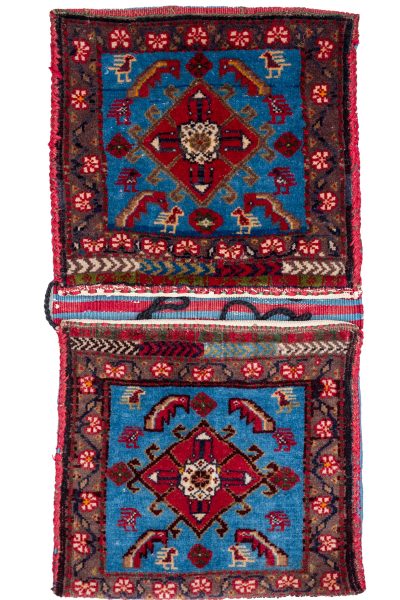
Kharjin Sirjan Bag
Size: 0.66m x 0.30m (2'2 x 1'0) £155.00
https://youtube.com/shorts/D2vfW3mZcks?feature=share
Add to basket
In stock

Azerbaijan Spindlebag
Size: 0cm x 0cm £210.00
Azerbaijan Spindlebag Azerbaijan Spindlebag These colourful carpets and rugs are hand-woven in Fars province of south-west West Asia and are brought to market in...
Add to basket
In stock

Kashan Rug
Size: 3.82m x 1.02m (12'6 x 3'4) £790.00
50-80 years old
Kashan is a city in the North of central West Asia and is famous for weaving some of the best quality carpets being produced. They are exceptionally hard wearing and highly decorative. These elegant rugs are constructed on a cotton foundation with a woollen pile, sometimes having accents of silk or woven entirely with silk.
Kashan rugs have been crafted since the 16th and 17th century, during the Safavid dynasty, with many scholars believing that some of the smaller silk designs date back to the early 16th century. Taking inspiration from the architects and artists of the period.
Many Kashan’s are distinctive with their traditional floral designs with deep reds and blues in the centre panel and border. They can also have only small accents of red and a main ground of mostly ivory and navy, making them similar to a Nain but woven in the city of Kashan. Depending on their size and colour they can work very well in both a bedroom as well as a hallway or living room for example.
Add to basket
In stock

Khan Mohamadi Rug
Size: 1.48m x 1.01m (4'10 x 3'4) £340.00
Khan Mohamadi Rug This vibrant Kazak has been hand woven by Afghan tribal people in Pakistan. It is based on the traditional Caucasian designs and...
Add to basket